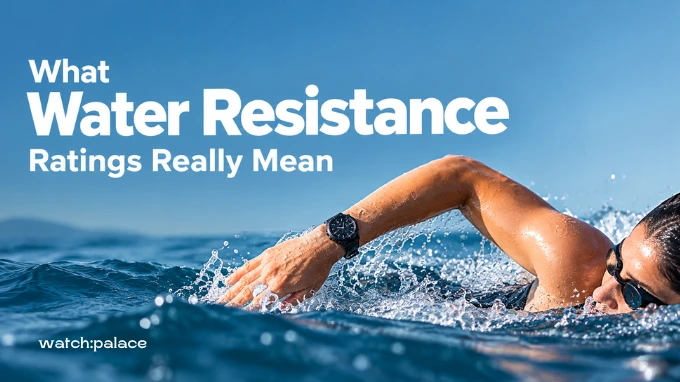
Don’t Ruin Your Watch! What Water Resistance Ratings Really Mean
Few features on a watch specification sheet cause as much confusion as water resistance ratings. A buyer will see “30 Meters Water Resistant” stamped on a case back and assume it is safe for a casual swim in a 3-meter deep pool—only to end up with a fogged-up dial a few hours later.
The reason? Water resistance ratings are measured under static laboratory pressure, not dynamic real-world movement.
Moving an arm through water, operating under a running tap, or jumping into a pool creates dynamic pressure spikes that place far greater stress on internal seals than static depth numbers suggest. Here is what those depth ratings actually mean when wearing a timepiece day-to-day.
30 Meters / 3 ATM / 3 BAR: Splash-Proof Only
- Real-World Use: Light hand washing, minor rain, everyday sweat.
- What to Avoid: Swimming, showering, or heavy downpours.
A 30m (3 ATM) rating is standard for dress watches and slim everyday models. The internal gaskets are engineered strictly to keep dust and brief accidental splashes out of the movement. Running tap water directly over the crown can easily exceed this pressure seal and allow moisture inside.
👉 Key Detail: If a 30m watch features a leather strap, keep it clear of water entirely—moisture degrades both the leather lining and internal components.
50 Meters / 5 ATM / 5 BAR: Daily Chores & Heavy Rain
- Real-World Use: Heavy rain, car washing, brief accidental immersion.
- What to Avoid: Lap swimming, diving, or high-pressure water jets.
A 50m (5 ATM) rating includes reinforced case-back seals and stem protection. While it handles sudden downpours and accidental submersion significantly better than a 30m watch, it is still not built to withstand the continuous arm movement and friction created while swimming.
👉 Key Detail: Never wear a 50m watch into a hot shower or sauna. Heat causes the metal case to expand and degrades rubber seals much faster than cold water.
100 Meters / 10 ATM / 10 BAR: Swimmer-Ready & All-Weather
- Real-World Use: Swimming pools, beach swims, surface snorkeling, monsoon weather.
- What to Avoid: Scuba diving with oxygen tanks or high-impact water sports.
A 100m (10 ATM) rating is the real threshold for active water exposure. Many versatile sports watches built to this standard feature sturdier case structures and double-gasket crowns designed to handle movement underwater.
200 Meters / 20 ATM / 20 BAR: True Diver & Tactical Grade
- Real-World Use: Scuba diving, high-impact water sports, marine activity.
- What to Avoid: Operating buttons or pulling out the crown underwater.
Watches rated at 200m (20 ATM)—such as ISO 6425 certified dive watches like those found in the Casio G-Shock or Seiko Prospex lines—utilize screw-down crowns, heavy-duty threaded case backs, and thick crystals. They are built to withstand intense pressure spikes during active marine use.
👉 Key Detail: Even on a 200m professional dive watch, never operate chronograph pushers or pull out the crown underwater, as doing so immediately breaks the watertight seal.
Quick Reality Check: What Can You Actually Do?
| Rating Stamped | Hand Washing | Heavy Rain | Hot Shower | Swimming Pool | Scuba Diving |
| 30m (3 ATM) | YES | NO | NO | NO | NO |
| 50m (5 ATM) | YES | YES | NO | NO | NO |
| 100m (10 ATM) | YES | YES | NO | YES | NO |
| 200m (20 ATM) | YES | YES | NO* | YES | YES |
Golden Rules of Watch Maintenance
- Rinse After Saltwater: Seawater leaves salt crystals upon drying, which can corrode steel and dry out rubber gaskets. Rinse 100m+ watches in fresh tap water after a beach swim.
- Beware of Steam: Steam molecules are smaller than liquid water drops and easily bypass water-resistant seals.
- Inspect Gaskets Periodically: Rubber O-rings harden over time. Have gaskets checked and pressure-tested during battery changes or routine servicing by Watch Palace specialists.